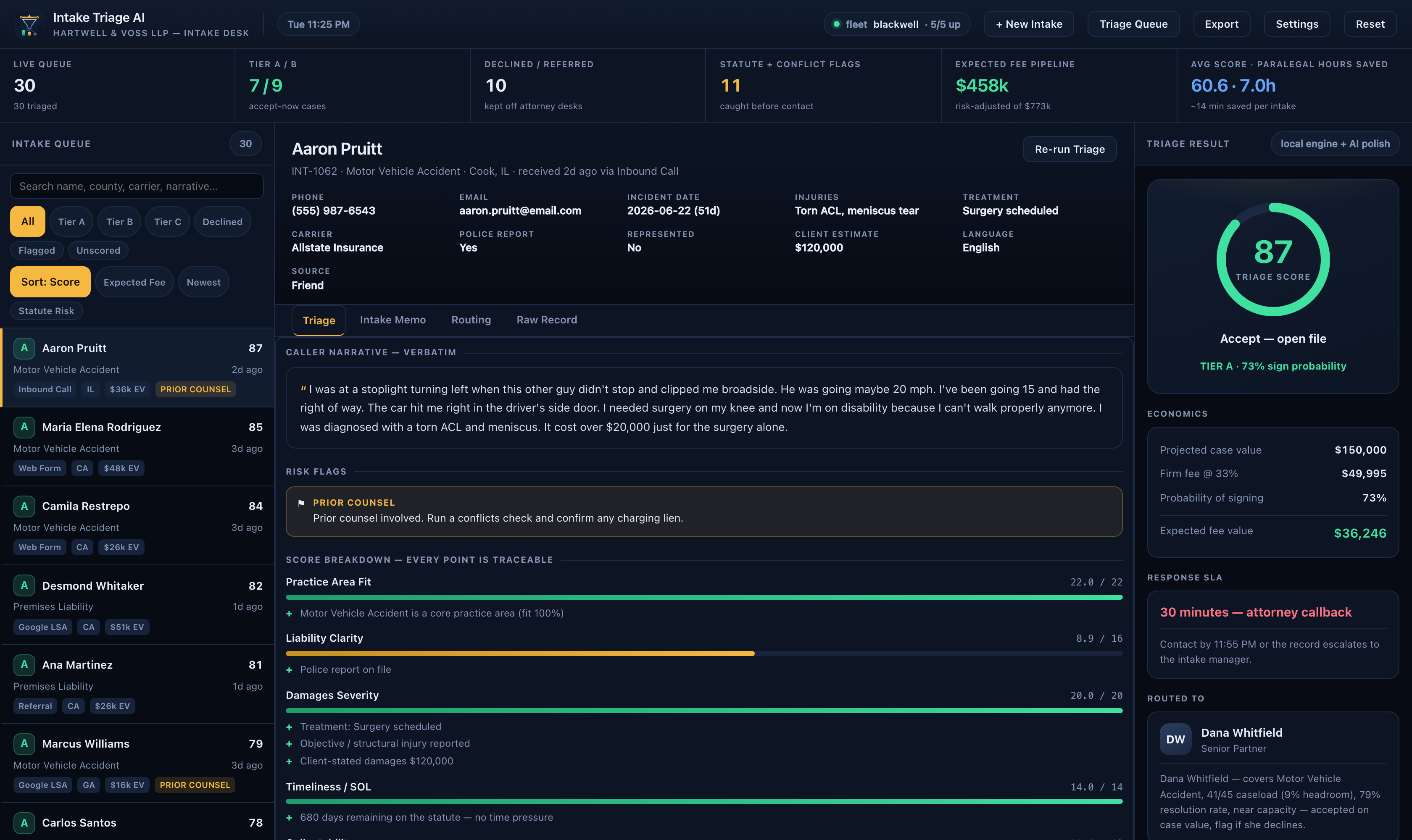
I am not letting software decide which cases we take.
It does not. It ranks and summarizes; a human accepts or declines every single time. What changes is the order
your team works the queue and how much context they have when they pick up the phone. In the two-week shadow
period it scores everything and touches nothing — you get a side-by-side of its ranking against your
paralegal's and you decide whether it earned any authority at all. Firms typically keep manual override on
Tier A cases permanently. That is fine. The value is in the 60% of the queue nobody was reading carefully.
Our intake person is good. Why would I pay $3,400 a month for this?
You are not replacing her. She is one person covering roughly 340 leads a month, which is 14 minutes of
attention per lead if she does nothing else for eight hours a day, and she is asleep between 6pm and 8am when
about 40% of accident-related form fills happen. This handles the first 60 seconds on all of them, at 2am,
in Spanish, and hands her a ranked queue with memos already written. Most firms redeploy that person onto
signed-case follow-up, which is where she was always more valuable.
What happens when it gets one wrong?
It will. Every score shows its own arithmetic — which line in the narrative moved which factor and by how
many points — so a wrong score is a visible, fixable disagreement rather than a silent one. Those
disagreements are the calibration input; we retune weights monthly against what you actually signed. The
deterministic rules engine also runs independently of any language model, so a model outage degrades the memo
prose, never the score, the statute flag or the routing.
Is our client data going to OpenAI?
No. This runs on dedicated GPU hardware — three RTX PRO 6000s plus a local node cluster — with no
third-party API in the path and no per-token metering. Narratives never leave infrastructure you can point at.
For firms that need it, the whole stack deploys inside your own network and we hand over the runbook.
We are on Filevine and it took a year to implement. How long is this?
Two weeks to shadow mode, four weeks to live routing, and it sits beside your CRM rather than replacing
anything. Integration is a webhook in and a memo plus a field write-back out. No data migration, no retraining
your staff on a new system, no change to how a matter gets opened.
Does this handle statute of limitations correctly across states?
It ships with a per-practice-area, per-state limitations table plus the administrative deadlines that bite
earlier — EEOC's 300 days, workers' comp employer notice windows. At setup we verify the table against
your actual filing jurisdictions with your own counsel before it goes live. It is a flag that forces a human
to look, not a legal opinion, and the memo says so on every page.
What is actually included in the setup fee?
Discovery on your current intake flow, weight and threshold calibration against 12–24 months of your
signed and declined history, the jurisdiction table build, CRM integration and field mapping, the two-week
shadow evaluation with a written accuracy report, attorney roster and routing rules configuration, and staff
training. It is refundable in full if the shadow report does not beat your current process on your own data.